








































Discover how gamification mechanics — points, challenges, leaderboards, and rewards — transform B2B customer engagement from a chore into a competitive sport your customers actually want to play.
Your customers log into your platform. They poke around. They do the thing they came to do.
Then they leave.
No deeper exploration. No feature discovery. No community post, no review, no referral. Just… in and out.
That’s not a retention problem. It’s an engagement problem. And the fix isn’t another nurture email.
It’s gamification — and the B2B companies that have cracked it are building advocacy flywheels that would make their competitors weep.
In this guide, we’ll break down exactly how to gamify B2B engagement: what it means, why it works, and how to implement it in a way that drives real business outcomes — not just vanity metrics. We’ll cover the psychological foundations, the mechanics that move the needle, real-world examples from companies doing it right, and where AI and automation are taking this playbook next. Whether you’re just exploring the idea or ready to build a full program, you’ll leave with a concrete framework for action.
Let’s get into it.
What Does It Actually Mean to Gamify B2B Engagement?
Gamification gets misunderstood constantly. Most people hear the word and think leaderboards and fun little badges — a superficial layer of “game-iness” slapped onto a serious product.
That’s not what we’re talking about.
Gamification in a B2B context means applying game design principles — progression systems, variable rewards, social recognition, and clear goal structures — to drive specific behaviors that matter to your business. It’s behavioral design, not decoration.
The Psychology Behind Why It Works
Humans are wired to respond to progress, reward, and recognition. Psychologist B.F. Skinner’s research on variable reward schedules — the same principle that makes slot machines compelling — shows that unpredictable, intermittent rewards drive behavior more powerfully than predictable ones. Apply that to your customer journey, and you have a legitimately potent engagement engine.
The science backs it up at scale. According to TalentLMS research, 89% of employees say gamification makes them more productive, and 88% say it makes them happier at work. In a B2B SaaS context where your customers ARE the “employees” of your platform — responsible for getting results from it — those numbers translate directly.
The core psychological drivers gamification activates are:
- Autonomy: Players choose which challenges to pursue, giving them a sense of control.
- Mastery: Progression systems show users exactly how far they’ve come — and how much further they can go.
- Purpose: Community leaderboards and social proof connect individual actions to a larger story.
- Relatedness: Competition and collaboration with peers creates belonging.
These aren’t soft, feel-good concepts. They’re the levers behind durable engagement.
Gamification vs. Gimmickry: Where Most B2B Programs Go Wrong
Here’s the caveat: gamification only works when it’s aligned with genuine value.
Slapping a points counter on a task your users already hate doesn’t make it fun — it makes it feel manipulative. According to a Harvard Business Review analysis, poorly designed gamification programs can actually reduce intrinsic motivation by making users feel like they’re being herded.
The rule is simple: gamify actions that your customers should want to take anyway. Completing onboarding, discovering a powerful feature, sharing a success story, referring a peer — these activities benefit the customer. Gamification just makes the journey more visible and rewarding.
Technology amplifies the effect. But authentic value is the foundation.
The mechanics only matter if the experience underneath them is worth engaging with. Let’s look at how to build that experience.
The Core Gamification Mechanics That Drive B2B Engagement
Not all game mechanics are created equal. Some drive short-term clicks; others build long-term advocacy. For B2B companies, the goal is always the latter.
Here are the mechanics that consistently deliver results when applied to gamified customer engagement programs.
Points and Progress Systems
Points are the simplest — and most foundational — gamification mechanic. Users earn points for completing actions: watching a product video, leaving a G2 review, attending a webinar, submitting a referral. The points accumulate into a visible score that represents their level of engagement.
The critical design principle: points must feel proportional. A customer who submits a qualified referral should earn significantly more points than one who opens a newsletter. If everything earns equal points, the system loses meaning — and users lose motivation.
Real-Life Example: Cisco’s Partner Experience Platform awarded partners points for completing training modules, engaging with new product content, and generating customer success stories. Partners who reached higher point thresholds unlocked priority support access and co-marketing opportunities. Cisco reported increased partner content engagement and faster enablement cycles as a result.
Done right, a points system turns passive product users into active platform participants — and active participants into advocates.
Tiered Status and Badging
Progression tiers — Bronze, Silver, Gold, Platinum, whatever language fits your brand — create aspirational roadmaps. Users know exactly what it takes to climb, and the status itself becomes a form of social currency.
Badges serve a slightly different function: they commemorate specific milestones and achievements. “First Referral Submitted.” “Product Certified.” “Community MVP.” These aren’t just digital trinkets — according to Badgeville research, badge-based recognition increases task completion rates by up to 49% in enterprise environments.
The emotional logic is straightforward: badges are visible proof of accomplishment. In a world where B2B buyers and practitioners are constantly building professional credibility, a badge from a platform they use signals expertise to their peers.
- Design 3–5 progressive tiers with clear requirements for each.
- Create milestone badges for first-time and exceptional actions.
- Make badges shareable on LinkedIn — turn your advocates’ achievements into your brand’s social proof.
- Reserve top-tier status for your most active advocates and publicly celebrate them.
Challenges and Quests
If points are the currency of gamification, challenges are the missions. A well-designed challenge gives users a specific goal, a time window, and a meaningful reward — and, critically, it directs their energy toward an activity your business cares about.
Examples of high-value B2B challenges:
- “Submit a customer story this quarter and earn 500 points + a personalized spotlight on our community hub.”
- “Complete our new AI features training track by the end of the month to unlock Gold status.”
- “Refer two colleagues to our upcoming summit and earn a co-branded resource kit.”
The time constraint matters. A challenge without a deadline is just a suggestion. Urgency is a core game mechanic — it converts intent into action.
Forrester research shows that customers who complete structured engagement programs are 60% more likely to renew their subscriptions than those who engage ad hoc. Challenges are how you create those structured pathways.
Leaderboards and Social Recognition
Leaderboards introduce competition — and with it, a powerful layer of motivation that pure progress systems can’t replicate. Seeing that a peer is 200 points ahead changes behavior in ways that abstract goals don’t.
But use them carefully. In B2B contexts, a global leaderboard that shows your top 1% can demotivate the middle 98%. The best practice: segmented leaderboards that show users their ranking within a relevant peer group — their industry cohort, their company’s users, or their regional community.
Real-Life Example: Adobe’s Community forums use a tiered recognition system that highlights top contributors on a rolling 30-day basis — not all-time dominance. This approach ensures new members can see themselves climbing the ranks, not staring up at an unreachable wall of legacy users. The result: Adobe reports that community contributors are among their highest-retention customer segments.
Recognition doesn’t have to be algorithmic, either. Spotlight posts, “Advocate of the Month” features, and executive shout-outs add human warmth to the competitive structure. That combination — game mechanics plus genuine human acknowledgment — is where the magic lives.
You’ve got the mechanics. Now let’s talk about how to build the program architecture that makes them work together.
Building Your Gamified B2B Engagement Program: A Step-by-Step Framework
Theory is easy. Execution is where programs succeed or fail.
Here’s the framework for building a gamified customer engagement program that actually scales — from architecture decisions to launch to long-term iteration.
Step 1: Define the Behaviors You Want to Drive
Start with the business outcomes, then work backward to the behaviors that produce them.
If your goal is pipeline generation, you want referrals and peer recommendations. If your goal is retention, you want feature adoption and community participation. If your goal is market presence, you want reviews, testimonials, and event speaking.
Map each desired business outcome to a specific, measurable customer action. Then design your points system and challenges around those actions — not the other way around.
Common high-value actions to gamify:
- Submitting a qualified referral
- Completing a product certification
- Leaving a verified review on G2, TrustRadius, or Capterra
- Participating in a case study or customer story
- Engaging in community discussions (starting threads, answering questions)
- Attending events or webinars
- Sharing company content on social media
Step 2: Segment Your Advocate Base
Not all customers are the same advocate type — and your gamification program shouldn’t treat them as if they are.
Power users who love your product may happily write detailed reviews and do case studies. Networked executives may be more inclined to make introductions and referrals. Practitioners who live in your product daily may be your best candidates for community leadership.
Segment your advocate base by engagement level, company tier, role, and advocacy type. Then customize your challenge tracks and reward structures accordingly. A one-size-fits-all program will under-serve all your segments.
Step 3: Design Your Reward Architecture
Rewards fall into three categories — and the best programs use all three:
Intrinsic rewards (recognition, status, community belonging) are the most durable motivators. They don’t cost you anything and they compound over time.
Extrinsic rewards (swag, gift cards, event invitations, software credits) provide short-term activation energy. They’re most effective for kick-starting engagement among newer advocates.
Professional rewards (co-marketing opportunities, speaker invitations, advisory board membership, early feature access) are the most powerful for senior B2B buyers. These rewards advance the advocate’s career and reputation — which is ultimately what B2B professionals care most about.
According to SiriusDecisions research, professional recognition and career development opportunities outperform monetary incentives as long-term advocacy motivators by a factor of 3:1 among director-level and above respondents.
Design your tier rewards to escalate from extrinsic (at entry level) to professional (at your top advocate tier). This creates a progression path that attracts early engagement and retains your most committed advocates long-term.
Step 4: Launch with a Founding Cohort
Don’t open your gamified program to your entire customer base at once.
Start with a founding cohort of 25–50 of your most engaged customers. Work closely with them to refine the challenge design, test the point values, and identify gaps in the reward structure. Use their feedback — and their early activity — to build social proof before the broader launch.
This approach also gives your leaderboard some initial data, so new members join a community that already has energy and momentum rather than an empty room.
Real-Life Example: Marketo launched its Champions Program with a small group of 20 hand-selected customers. Those founders shaped the program’s culture and defined its value proposition. By the time the program opened more broadly, it had a visible community of successful advocates whose activity attracted others. Today, the Marketo Champion community has expanded to hundreds of members who generate tens of thousands of peer interactions annually.
Step 5: Measure, Iterate, and Expand
Your gamification program is a product. Treat it like one.
Track engagement rates by challenge type, average points per cohort, leaderboard activity, and — critically — conversion from advocacy action to business outcome (referral to pipeline, review to deal influence, community post to retention).
The metrics that matter most:
- Activation rate: % of invited advocates who complete their first challenge
- Monthly active advocates: unique advocates completing at least one challenge per month
- Advocacy pipeline contribution: revenue influenced by advocate-sourced activities
- Advocate NPS: are your program members more satisfied and loyal than non-members?
Iterate based on data. If a challenge type has low completion rates, redesign the ask or increase the reward. If a segment is disengaged, test a new challenge track tailored to their role.
With your program architecture in place, let’s look at where this space is heading — because the playbook is evolving fast.
The Future of Gamified B2B Engagement: AI, Automation, and the Next Frontier
We’re in the early innings of what gamified customer engagement will eventually become. The programs that are outperforming today are already incorporating AI-powered personalization — and the gap between AI-enabled programs and manual ones is only going to widen.
AI-Powered Challenge Personalization
Today, most advocate programs offer the same challenge menu to every participant. Tomorrow — and for early adopters, already today — AI will analyze each advocate’s behavior, role, engagement history, and preferences to surface the specific challenges most likely to resonate with them at any given moment.
Imagine a system that detects when a customer has just hit a major milestone in your product and automatically surfaces a “Share Your Win” challenge — perfectly timed to capitalize on their excitement. That’s not sci-fi. It’s where AI in customer advocacy is heading in 2026.
Influitive’s Groovy AI is already pushing in this direction, bringing machine learning to advocate matching, challenge recommendations, and reference management — automating the heavy lifting so your team can focus on relationship strategy rather than operational logistics.
Reference Deflection at Scale
One of the costliest hidden problems in B2B is reference burnout: your best customers get asked to do too many reference calls, too often, until they stop responding entirely.
Gamification solves this by creating a larger, more active pool of advocates — so the load is distributed rather than concentrated on your top five. AI solves it further by intelligently matching reference requests to the right advocate at the right time, reducing the frequency of asks on any individual.
Automated customer proof — where AI helps curate and surface existing testimonials, case studies, and review content in real time — takes reference deflection a step further, helping sales teams close deals without even making a live reference request when existing proof is sufficient.
Community-Led Growth as a GTM Motion
The most forward-thinking B2B companies aren’t just building advocacy programs. They’re building community marketing platforms that become living ecosystems — where customers help each other, generate peer content, and organically recruit new members.
According to research from CMX Hub, companies with active customer communities see an average 25% improvement in churn reduction and a 15% increase in upsell revenue. When those communities are gamified, the engagement numbers compound.
The companies building gamified communities today are constructing durable competitive moats. Customer communities are not easily replicated by competitors — because they run on trust, history, and human relationships that take years to build.
Gamification Maturity: From Tactics to Culture
The final frontier of gamification isn’t a feature — it’s a culture shift.
The most mature programs evolve past “here are some challenges to complete” into “here is a community where your engagement is recognized, rewarded, and celebrated.” When advocates feel genuinely valued — when they see their participation shaping your product, their careers, and their industry — the extrinsic rewards become almost irrelevant.
That’s the north star: a program so intrinsically rewarding that your customers would participate even without the points.
We’ve covered a lot of ground. Let’s bring it home.
Conclusion: Gamification Is a Strategy, Not a Feature
We’ve traveled from the psychology of progress to the architecture of world-class advocate programs to the AI-powered future that’s already arriving.
Here’s what to carry forward.
Gamification works because it aligns technology with human nature — the fundamental drive to achieve, improve, compete, and belong. In a B2B context, those impulses don’t disappear just because the setting is professional. They just need a structure to express themselves through.
The companies winning with gamified engagement aren’t doing it because they added a leaderboard to their community portal. They’re doing it because they designed a full ecosystem — clear behavioral goals, tiered rewards that escalate in professional value, social recognition that builds status, and AI-powered personalization that makes every interaction feel relevant. They’ve also been honest about the effort required: gamification programs need dedicated management, continuous iteration, and a genuine commitment to delivering value to advocates, not just extracting value from them.
And perhaps most importantly: they’ve remembered that software is the amplifier, not the engine. The engine is authentic human relationships between your company and your customers. Gamification just turns those relationships into a scalable, measurable growth motion.
Start small. Identify your founding cohort. Design your first three challenges. Measure obsessively. Iterate.
The playbook is in your hands.
Elevate Your Customer Engagement with Influitive
If there’s one platform built specifically for everything we’ve covered in this article, it’s Influitive.
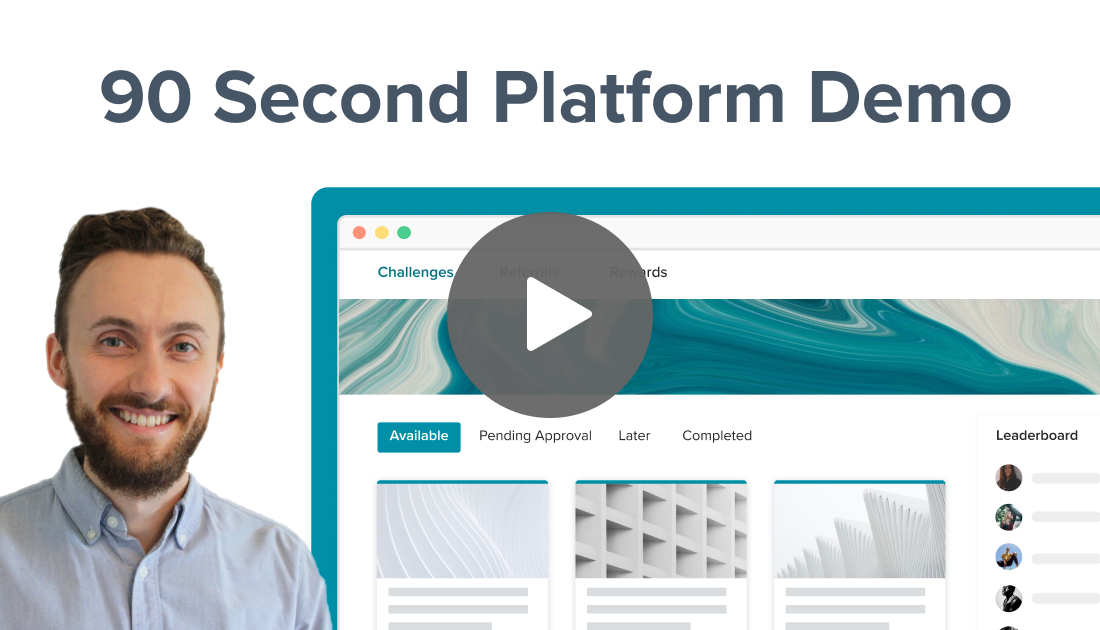
AdvocateHub — Influitive’s core platform — is purpose-built for gamified B2B customer engagement. It lets you design and deploy challenges, manage tiered rewards, run referral programs, and build community experiences without patching together a dozen disconnected tools. Every mechanic we described — points, badges, leaderboard, challenges, tiers — is native to the platform.
Groovy AI brings artificial intelligence to your advocacy program, automating challenge recommendations, reference matching, and advocate identification so your team spends less time on logistics and more time on strategy.
Customer reference management within Influitive solves the burnout problem directly — organizing your reference pool, tracking engagement frequency, and ensuring no single advocate gets over-indexed. Combined with Influitive’s referral pipeline tools, you get complete visibility into how your advocacy program is generating real revenue — not just activity metrics.
And with deep integrations into Salesforce, HubSpot, Marketo, and Slack, Influitive fits into the GTM tech stack you already have — not around it.
If you’re ready to turn your customers into a scalable, gamified growth engine, Influitive is where that program gets built.